
Asthma is inflammation of the tubes of the lungs which causes them to be obstructed, and therefore air passes though them less easily.
Symptoms
The main symptoms are:
- Difficulty breathing or "shortness of breath", associated with a "tight" feeling. This may be associated with exercise, come on at night, or on exposure to various external stimuli.
- Audible wheeze is often present
- Cough may be the main symptom in some children
Causes
The cells in the lungs react to various irritants such as:
- Substances to which the individual is allergic (allergens) such as house dust mites, cat or dog fur, horses, or pollen
- Chemical irritants, such as cigarette smoke, pollutants from factories and car exhausts, household cleaners and sprays, perfumes, etc.
- Low temperatures
- Exercise
This causes the tubes in the lungs to narrow which results in difficulty breathing.
Asthma frequently runs in families and is closely associated with hayfever and eczema. Sometimes other members of the family will have asthma, hayfever or eczema, or combinations of these. It is essentially caused by an allergic type of reaction of the immune system. Sometimes the irritants which set off the reaction are not strictly allergens but chemical irritants, for example smoke and fumes.
In families with a strong history of this sort of condition, the genes which cause asthma are probably in place from birth but the condition is activated by outside factors. These factors may include excessive exposure to house dust mites or smoke in the first few months of life, illness such as a severe infection, or exposure to irritant chemicals. There are various theories about why asthma is becoming more common, but some of these require more work to confirm or refute them.
Diagnosis
Your doctor will want to demonstrate that your air flow is significantly limited at times and that this is reversible. He is likely to do this by asking you to use a peak flow meter, which measures the fastest rate at which air comes out of your lungs when you blow into it as hard as you can. You will probably be tested in the surgery and then be given a prescription to get a meter of your own and asked to record regular readings.
You usually record these in a simple graphical form and take the best of three readings, twice a day. You may find this is easier to do using an app for your phone or tablet computer. Your doctor may also give you an inhaler to try, which eases airway obstruction, asking you to record readings before and twenty to thirty minutes after using the inhaler.
Sometimes your doctor may wish to give a course of steroid tablets to assess the impact on your peak flow readings.
With all or some of these, your doctor should be able to find out whether or not you have asthma. In children who are too young to cooperate with peak flow readings the diagnosis can be more difficult, and is often built up by the pattern over time and response to various medications.
Treatment
As with most conditions you can treat asthma with drugs from your doctor and by trying to prevent the symptoms of asthma. Avoiding dust and other irritants that trigger asthma is an example of treating your asthma by preventing it occurring in the first place.
There are two main types of drugs used for treating asthma and these are most commonly taken using an aerosol inhaler.
There are preventers that are taken every day, even if you feel well. They reduce the sensitivity of the cells in the lungs to house dust mites and other allergens. Some of these do not contain steroids (for example sodium cromoglycate), and others which tend to be more effective, especially in moderate to severe asthma, contain steroids (for example beclometasone, budesonide or fluticasone). The steroid inhalers are usually a shade of brown or maroon, or sometimes peach coloured.
The amount of inhaled steroid that reaches the lungs can vary between inhalers produced by different manufacturers, even if they have the same active ingredient. For this reason your doctor is likely to prescribe the inhaled steroid using a brand name rather than the widely used chemical name for the active ingredient (the generic name). This is to ensure that you always get the same brand and so the same dose of the active ingredient reaching your lungs.
In the usual doses prescribed the total steroid dose to the body from these inhalers is not enough to cause significant adverse effects. It is wise, however, to rinse the mouth and throat by gargling with water after use of inhaled steroids. Any steroid that is left on the mouth and throat will not help your asthma and may predispose you to infections in the throat and a hoarse voice. Alternatively, with young children, encourage them to brush their teeth after using their preventer inhaler. (This should also please the dentist!)
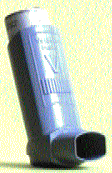
This is salbutamol, one of the relievers available.
There are also relievers that are taken when you feel tight. If you have to take one more than once or twice a day, you should consult your doctor, because your doctor is likely to adjust the dose of preventer that you are on. The relievers include salbutamol and terbutaline, and the inhalers are usually a shade of blue.
There are other inhalers containing medication that works by a different mechanism to cause opening of the tubes as well as reducing secretions, and others which are long acting forms of the tube opening (bronchodilator) medications. These may be added to your treatment if your doctor thinks it necessary.
One of the major problems with inhaled treatment is getting it to the right place in the lungs in adequate concentrations to have the desired effect. Although some people can use an inhaler well, others find the coordination of squeezing the device and inhaling the measured burst of medication very difficult to master.
There have thus been many attempts at alternative delivery systems:
A "spacer" device between the aerosol and the patient. This may be a large volume spacer, which is usually about the shape and size of a one litre lemonade bottle, or a small volume spacer, which is a smaller circular tube. This results in much better distribution of the inhaled substance in the lungs, by allowing the medication to "hang" in the spacer until the patient breathes in. As well as improving delivery, this also reduces side effects in the mouth and throat which sometimes happen as a result of the pressurised medication hitting the throat at 80mph.
Aerosols which automatically trigger when you breath in.
Powder forms of the medication which are sucked into your lungs when you breath in, avoiding the need for an aerosol gas.
Aerosol inhalers and the propellant used may vary between manufacturers, so your doctor may specify the brand of the inhaler in order to ensure that you always receive the same product.
There are also tablets which open the tubes in the lungs and some of these also have anti-inflammatory effects. These may be used in some circumstances.
A newer form of preventative medication, leukotriene receptor antagonists, are now also used. It is taken in tablet form and works more specifically on the immune system. This group are thought to be "cleaner" drugs than the steroids which are currently the mainstay of treatment, as they are more specific to the task involved. However at present they are used alongside inhaled steroids and are aimed at mild to moderate asthma. So far they have proved to be very effective.
Prevention
If possible avoid known triggers of asthma, that is irritants known to make your breathing worse. If you smoke, stop.
Sometimes complete avoidance of trigger factors is impossible, as in the case of house dust mites, but you can take the following measures to lessen the house dust mite population:
Cover all beds with a protective covering that does not allow the house dust mites to come through. It is also more hygienic because it can be easily wiped clean.
Vacuum regularly with a vacuum cleaner with an efficient microfilter. If possible do this daily, including the mattress (if it does not have a protective covering) which is where house dust mites breed. It is better if the person who suffers from asthma does not have to do this, as even with a high efficiency filter the actual process of vacuuming stirs up dust in the room air.
Monitoring Asthma
Patients themselves develop a very good idea of the severity of their asthma on a day to day basis, but it helps both you and your doctor to have an objective measure of the condition. Listening to the lungs is not very helpful, but peak expiratory flow meters (peak flow meters) give a very accurate idea of how tight the airways are.
These measure the fastest rate at which air comes out of your mouth when you blow as fast as you can. The measurement relies on maximum effort, but assuming that this is achieved, the power of the muscles involved in blowing will not vary from day to day, and so changes in the reading are a result of change in the diameter of the airways. A small change in diameter causes a fairly large change in air flow and thus the reading is very sensitive.
Further information
Books
- BMA family doctor series: Understanding asthma, by Professor Jon Ayres
- An up to date guide for patients on asthma, written by one of Britain's leading experts.
- Beat your allergies (52 Brilliant ideas series), by Dr Rob Hicks
- An excellent book, written by a British General Practitioner, which is easy to read, well laid out, and full of helpful ideas.
- Family guide to asthma and allergies, by American Lung Association Asthma Advisory Group
- An informative guide to how to live with your asthma.
- Asthma: The complete guide to integrative therapies, by Dr Jonathan Brostoff
- From a leading London allergy expert, this guide shows the reader how they can beat the illness. It includes alternative medicine and breathing exercises.
- Living with asthma, by Dr Robert Youngson
- A self help book describing the condition, treatments, and what to do in an emergency.
Related products
You can find asthma related and other useful products in the Medinfo Shop.
